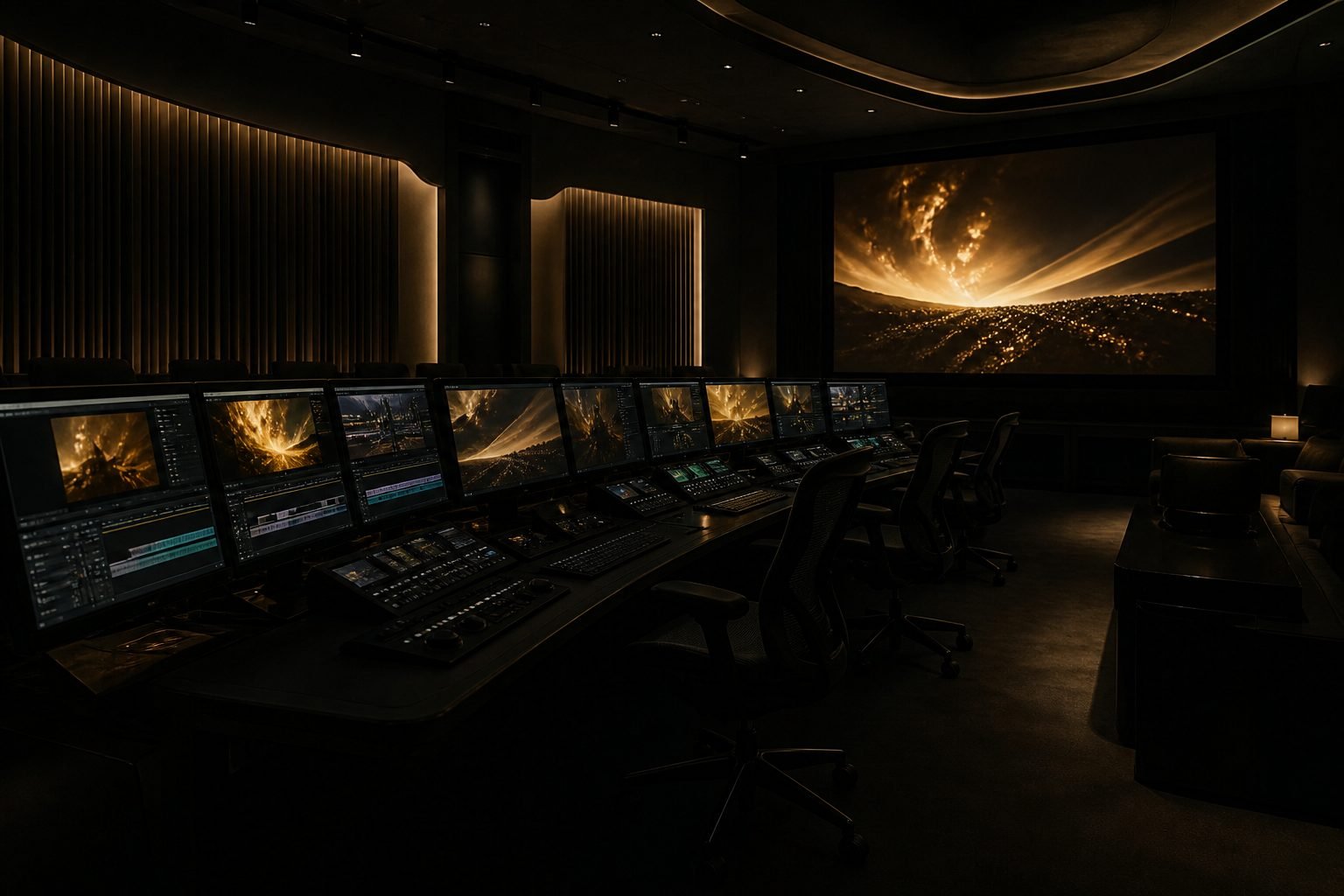
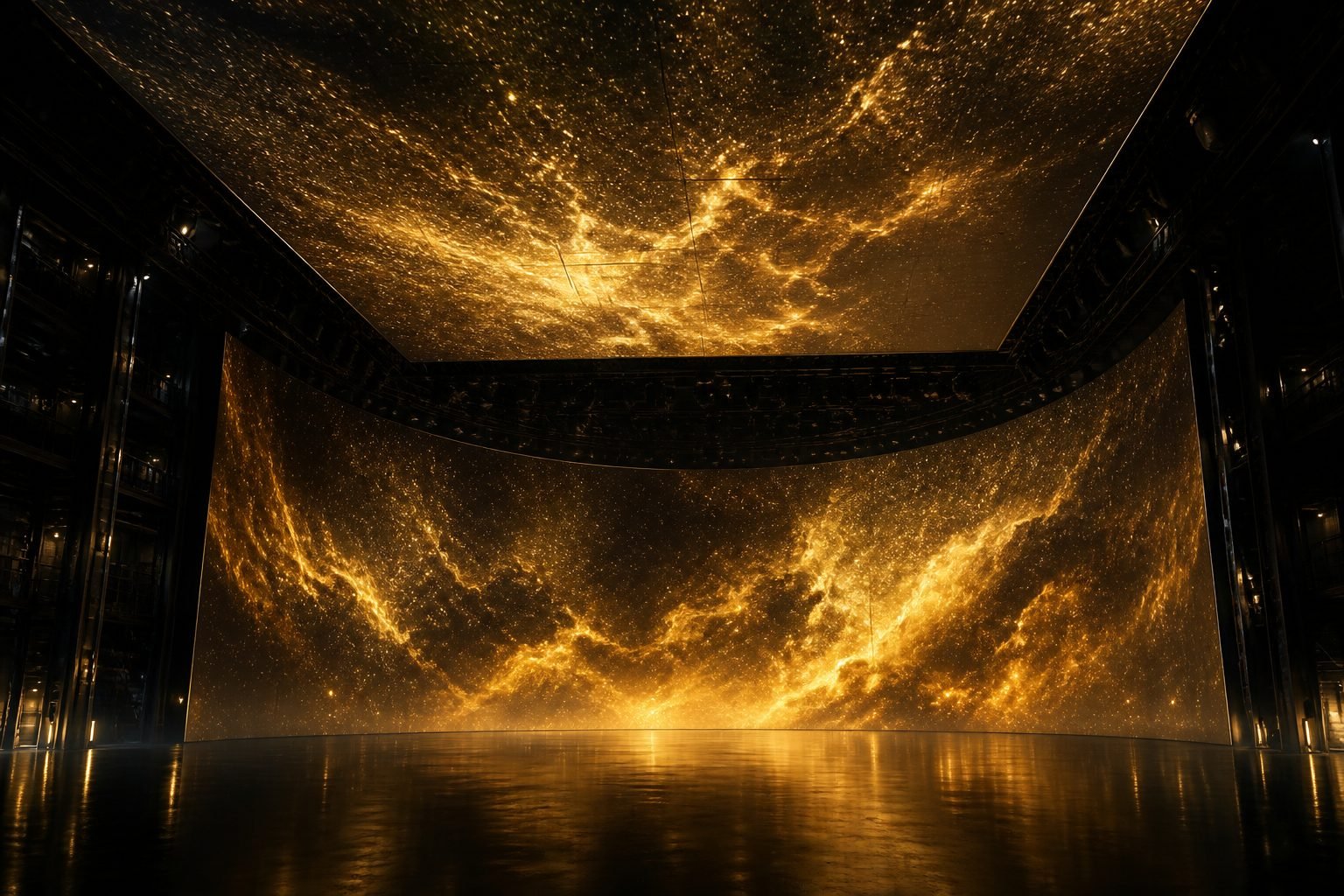
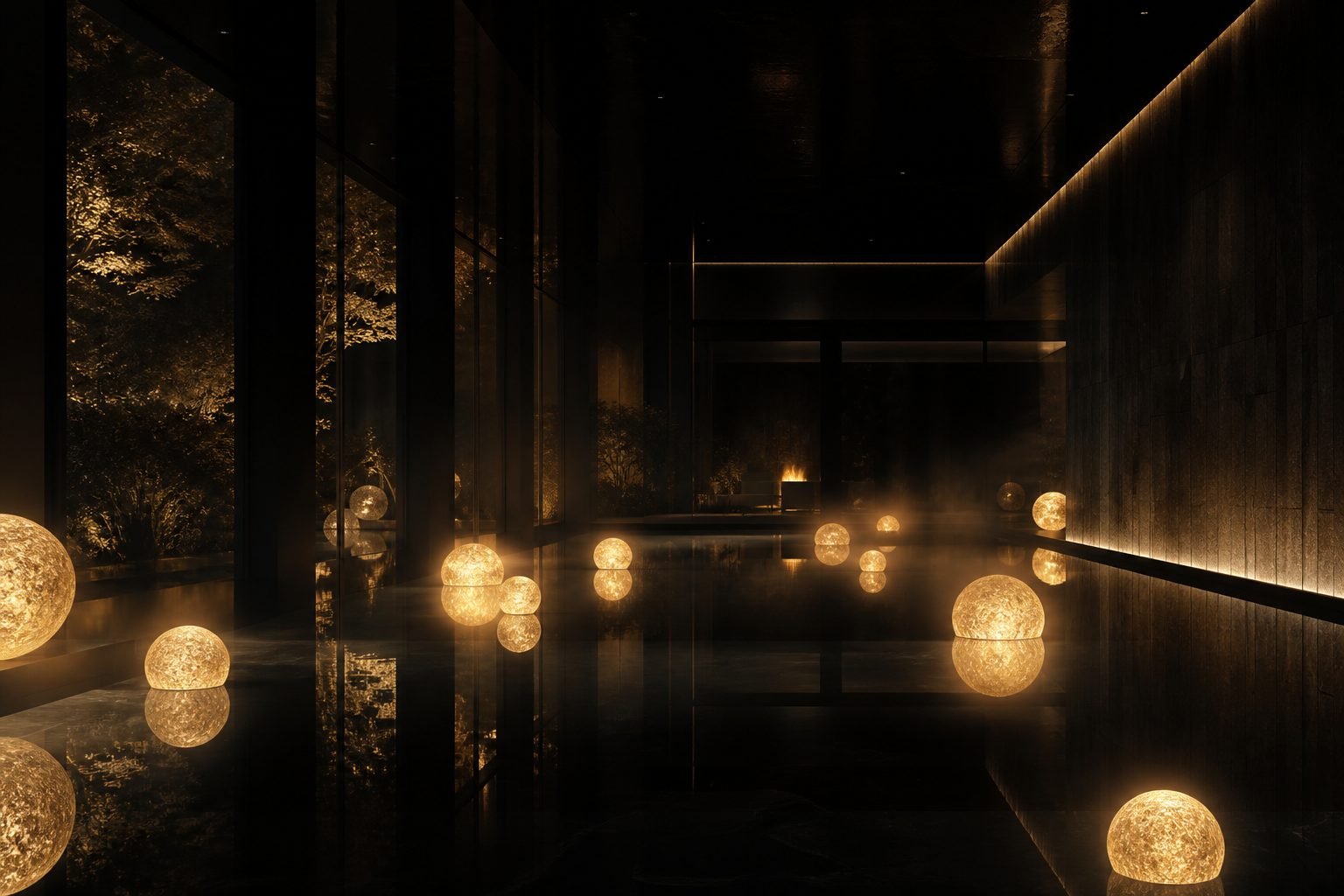
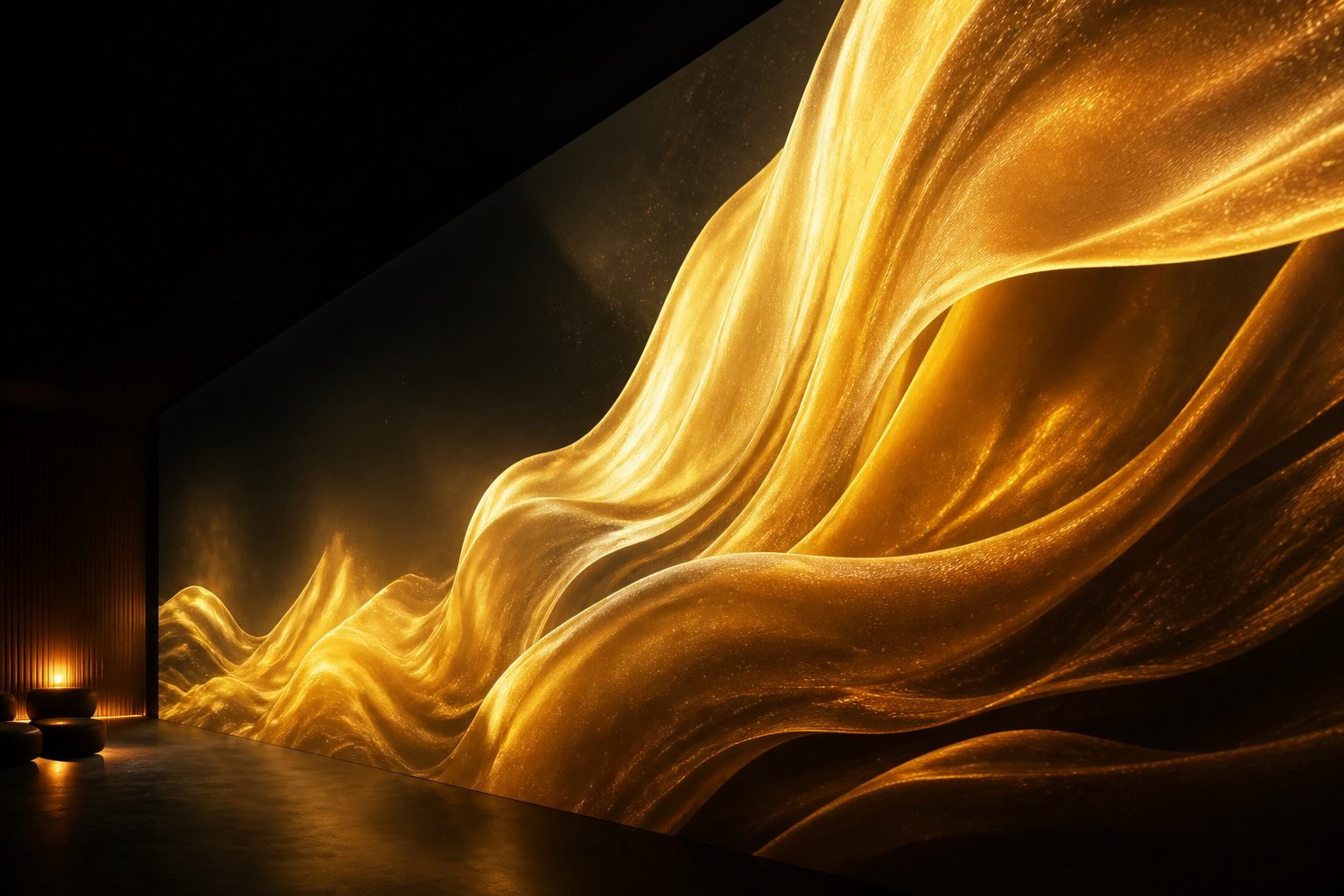
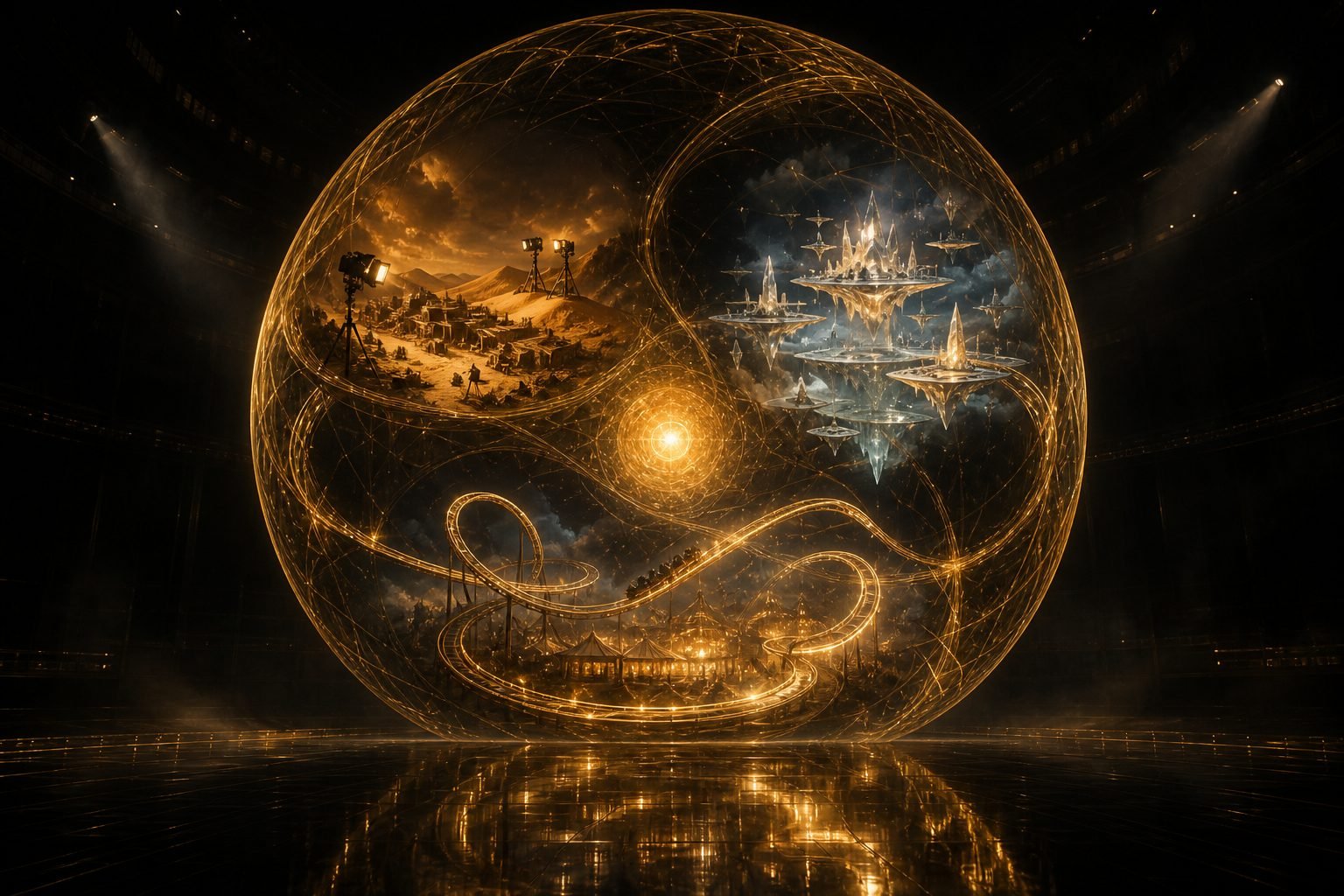
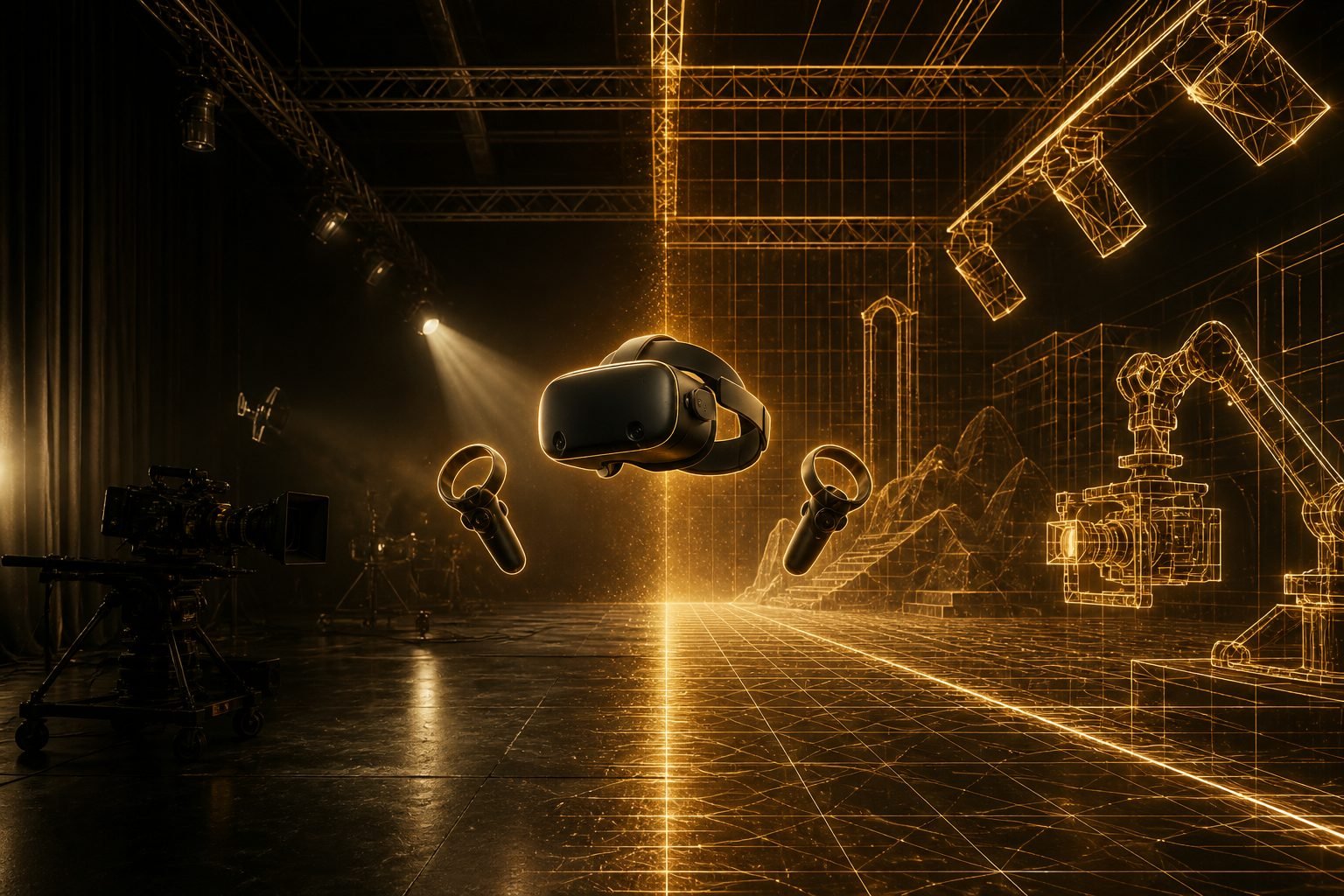
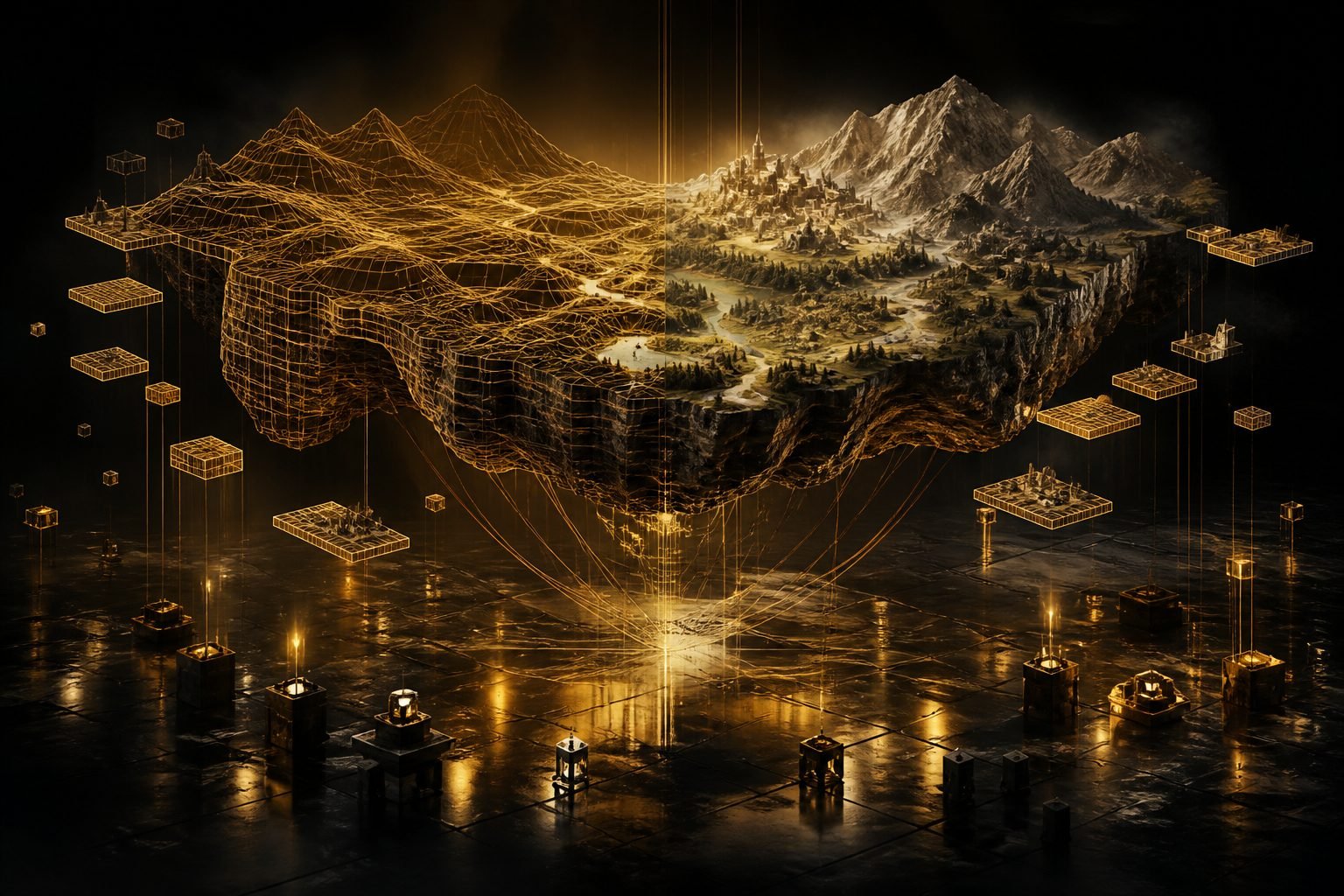
Four systems, one stack, resident on the campus: an AI film studio that directs like a studio, audio that becomes the room, a next-generation compute fabric, and the design practice that turns all of it into experiences people remember.
A coordinated AI film-production platform — a studio, not a single tool. Specialized AI agents act like studio departments under a Director agent, carrying a project from first draft to finished scene.

Patent-pending dual-pipeline architecture developed with technology partner J4.AI: a Human Pipeline where every stage can run entirely by people, and a Machine Pipeline of purpose-built production AIs — running side by side, with per-step accelerator buttons that are strictly choices, never takeovers.
The workflow chain runs vision → log line → plot summary → script outline → script → shot outline → shot list → annotated metadata, with cast, costume, lighting, and sound design coordinated across the whole production — consistency maintained over long-form work, not just short clips.
Real footage is a first-class citizen: attach a 4K camera clip or a 70 mm IMAX scan at any point in the workflow and blend it with generated material.
On this campus, Cinema's output doesn't ship out for finishing — it drives the stage next door.
Every stage doable entirely by people. Nothing automated by default. The creator stays in charge; the agents do the coordinating.
Purpose-built AIs trained on specific, large corpuses of production expertise — writing, design, cinematography, sound — coordinated like studio departments.
Captured film assets attach at any workflow point and blend with generated material. Shot on our stages, finished in the same pipeline.
One delivery layer. One creation layer. Planar Matryxx™ ships today in Avvolgente, Campo, and Nucleo configurations; Cervinia pairs it with Marziani Cinema™ to close the loop from first idea to installed guest experience.
Planar Matryxx™ arrays — in Planar Magnetic and Planar Dynamic variants — are many small drivers moving in phase to build a single continuous wavefront. Not a cone of sound aimed at one seat: a coherent field that holds together from the front row to the back wall.
Cervinia is the integration: concept briefed in Cinema → AI production → spatial design mapped to the physical room → show integration with timecode and venue systems → the Matryxx array reproducing the mix as one wavefront → every seat, every guest, at full fidelity.
The same six stages that shoot the content can premiere it — an audience-rated room, an installed wavefront, and the AI pipeline that wrote the show.

| Cervinia pipeline | What happens |
|---|---|
| 01 · Concept | A plain-English brief enters Marziani Cinema™ |
| 02 · AI Production | Agents generate scenes, characters, cinematography, sound direction |
| 03 · Spatial Design | Sound and visuals are mapped to the physical space and show flow |
| 04 · Show Integration | Integrates with show control, timecode, and venue systems |
| 05 · Matryxx Array | The mix is reproduced as one coherent wavefront |
| 06 · Guest Experience | Every seat, every guest — at full fidelity |
The compute fabric underneath it all. The LFP is J4.AI's proposed purpose-built silicon for J4 Stochastic Learning — a non-neural learning method positioned the way the NVIDIA GPU was for neural networks.

The thesis is efficiency: stochastic learning searches for predictive stochastic relationships instead of running matrix arithmetic — with J4 reporting 10³–10⁴× efficiency gains over neural networks, and dedicated LFP silicon projected to add roughly another 10³× on top.
The benchmark is the brain: three to four pounds, about twelve watts. The LFP roadmap — chip architecture, compiler, runtime, SDK, reference systems, from LFP Edge modules to LFP Data Center accelerators — targets useful predictions per joule as the performance curve that matters.
Room-temperature classical silicon. No cryogenics. Not quantum. An NVIDIA GPU bridge implementation lets stochastic learning run on today's hardware while the silicon is developed.
FIGURES ARE J4.AI'S OWN; INDEPENDENT VALIDATION IS IN PROGRESS. PATENTS WO2024258795A1 · US20240419998A1.
The design practice that turns technology into feeling. Qualia Forge designs the inner experience first, then engineers the world outward to produce it.
Brand experiences, permanent installations, sensory environments, shared-reality chambers, touring shows, concert scenography, and holographic performance — no headsets; human scale, proven against the worst seat on the site plan first.
A practice built for Ferrari, Mercedes-Benz, ASICS, Nestlé, the Netherlands Pavilion, Boston Scientific, and holographic productions at Ziggo Dome scale — with in-house projection surface technology and the Projection Planner, a free browser tool built on real lens data and brightness arithmetic — qualia-forge.com.
On the campus, Qualia Forge is the bridge from pipeline to audience: whatever Cinema imagines and the arrays deliver, the Forge makes it something a crowd stands inside.
Launch theatre for the world's marques — reveals staged as architecture, light, and motion.
Museum and pavilion works that hold up for years, not weeks — light as material.
Full-height volumetric presence on stages the eye cannot find the screen in.
Kinetic light architecture built to travel — arena-scale shows that pack into trucks.
Private estates and quiet luxury — environments measured in what remains afterward.
In-house deep-black projection surface technology — true color in spaces that cannot be darkened.
Concept render — watch the stage become a universe. View on YouTube
QUALIA FORGE IS AN INDEPENDENT LOS ANGELES DESIGN PRACTICE · SEE THE FULL PORTFOLIO AT QUALIA-FORGE.COM
While the film is in production, the same stages, the same assets, and the same AI pipeline are building everything else — the game, the VR experience, the ride. All released the same day the movie premieres. Nowhere else on Earth can you do this.

One asset universe, every medium at once. The moment Marziani Cinema™ blocks a scene, the environments, characters, and lighting exist as digital assets — ready to become game levels, VR chapters, and ride environments without a single rebuild. The movie set IS the game map IS the ride track.
Same-day release, by design. Film, game, VR, and attraction converge on one premiere date — each medium amplifying the others from day one, instead of licensing deals chasing a hit two years later.
This is what an AI-native campus makes possible: the marginal cost of the next medium collapses, so the franchise ships whole.
Direct in the world you're building. VR headset and virtual camera rigs walk the stage floor while the scene renders around you — blocking, framing, and lighting a scene from inside it, with Marziani Cinema™ capturing every choice.
Every set built for the film is born game-ready: real-time engine assets, playable from the first week of prep. The AI pipeline generates levels, props, and environments from the same canon the script lives in.
Audience-rated stages double as ride development labs — full-scale mockups, motion profiles, and show systems designed in the same rooms where the film's world was born, with Planar Matryxx™ wavefront audio already installed.
Make the movie. Simultaneously make the game, the VR world, and the ride — in one place, on one pipeline, for one release day. No other location on Earth offers this.
Marziani Cinema™ writes and produces. Planar Matryxx™ and Cervinia deliver it into physical space. The J4 Logic Field Processor aims to power it at a fraction of the energy. Qualia Forge designs the experience the audience actually receives. At LA Center Studios, all four live and work on the same campus — stages, offices, machine rooms, and show floors connected by fiber.
An AI pipeline that can pull cloud GPU over metro dark fiber, shoot on six 18,000 sq ft stages the same day, and premiere the result in an installed wavefront room before the crew wraps — that's not a collection of vendors. That's one instrument. And it only exists where the stages, the fiber, and the stack are all in one place.