IE NewsThe CampusMarziani
InMersion Systems™
One WilshireThe FieldeVTOLWellness Book the Campus
eVTOL · The Campus Vertiport

The air-taxi race has three leaders.
Here is each of them.

Electric vertical take-off and landing aircraft are about to change how cities move. Three programs lead the field in the United States — three companies, three aircraft, three different answers to the same question: what should an air taxi be? A neutral field guide, from the campus vertiport at 1201 W. 5th Street.

The Top Three

Three companies. Three aircraft.

The eVTOL field counts more than 800 programs worldwide, but in the United States three names sit at the front of the pack. Each leads for a different reason — certification progress, launch partnerships, or engineering heritage. This page presents each on its own terms.

Company 01 — Joby Aviation

Joby: the certification leader.

Founded in 2009 and headquartered in Santa Cruz, California, Joby Aviation has spent more than a decade and over a billion dollars on a single aircraft: the Joby S4, a five-seat (four passengers plus pilot) battery-electric air taxi with six tilting propellers and a ~100-mile range on a charge.

Joby is generally assessed as the commercial-readiness leader in the West. Its aircraft is in Stage 5 — the final stage — of the FAA type-certification process, with FAA-conforming production aircraft flying from its Marina, California pilot-production line since March 2026. In the UAE, Joby has a six-year exclusive air-taxi agreement with Dubai's transport authority, and is targeting passenger service in Dubai as its first market. Toyota is both an investor and its manufacturing partner, and Delta, Uber, and Blade back the launch network.

PROGRAM STATUS PER COMPANY DISCLOSURES AND INDUSTRY REPORTING, OCTOBER 2026.
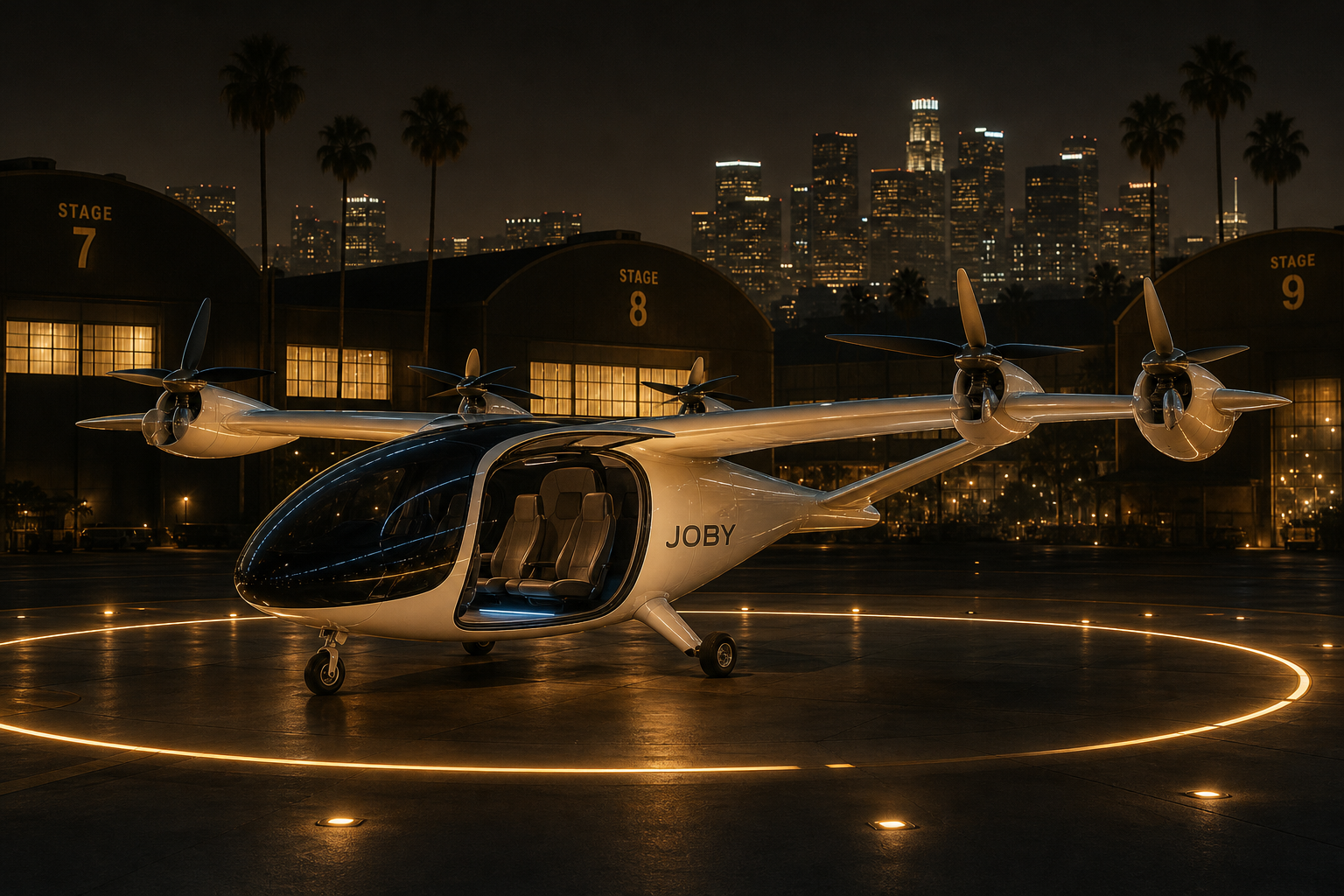
Concept render: a Joby-style electric air taxi parked on the campus vertiport at night
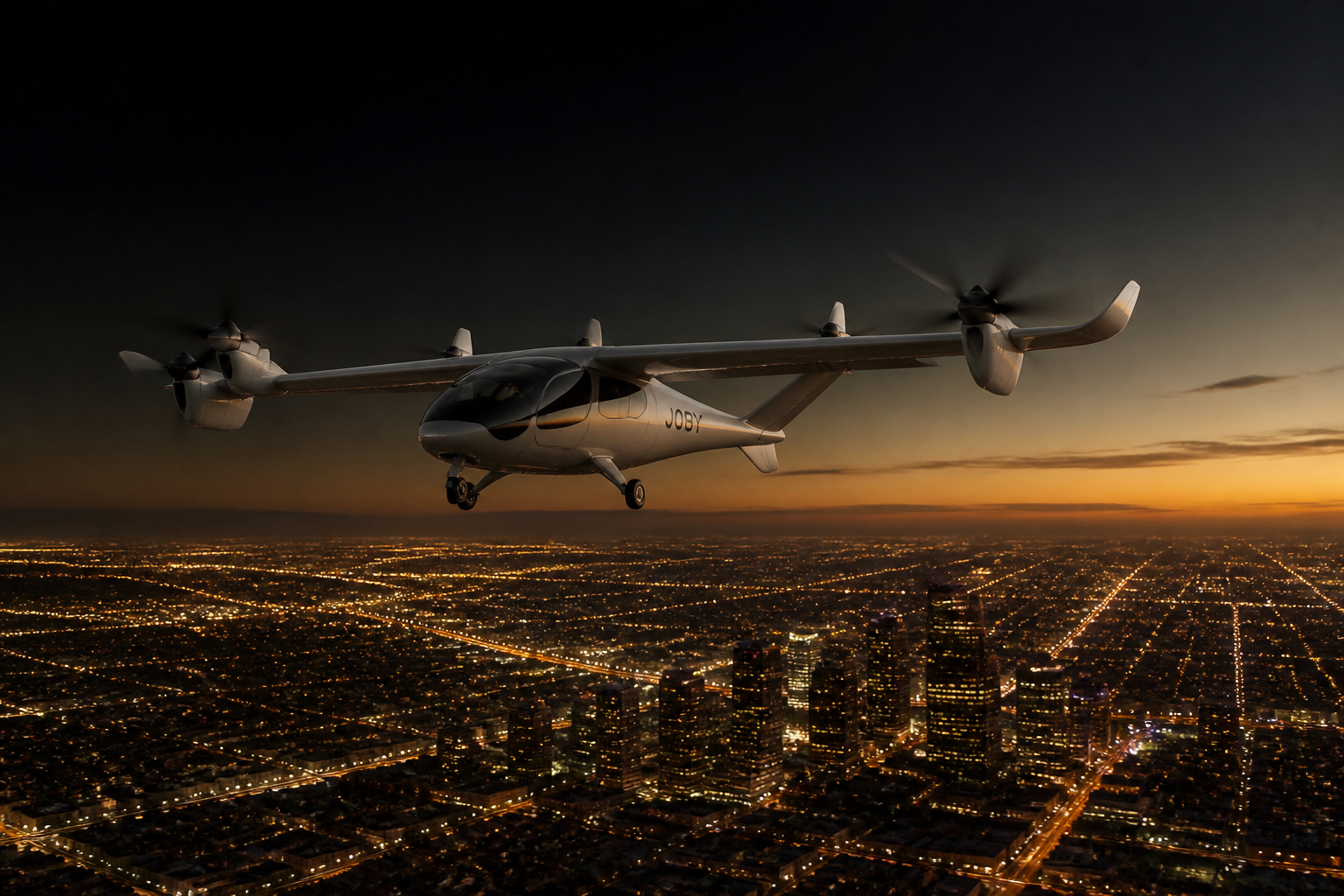
Concept render: a Joby-style air taxi in cruise flight over the Los Angeles basin at dusk
THE AIRCRAFT — S4

Six rotors, one wing, a hundred miles.

The S4 is a lift-plus-cruise design with a high wing and six propellers: four large tilting props on the wingtips and two smaller lift props on the wing centerline. Tilt the front props forward and it cruises like a conventional aircraft on a wing; point them up and it lifts off vertically, no runway required. The cabin carries four passengers with a pilot, and the battery-electric powertrain is engineered to be quiet enough to land in neighborhoods — one of Joby's most-cited acoustic demonstrations to city regulators.

Joby S4 — Program Card
CompanyJoby Aviation (NYSE: JOBY), Santa Cruz, CA — founded 2009
AircraftJoby S4 — battery-electric, 5 seats (4 passengers + pilot)
ConfigurationLift + cruise: 6 propellers (4 tilting wingtip + 2 lift), high wing
Range~100 miles on a charge (company target)
CertificationStage 5 of 5, FAA type certification — FAA-conforming aircraft flying since March 2026
Launch marketDubai, UAE — six-year exclusive with Dubai RTA; passenger service targeted 2026
PartnersToyota (manufacturing investor), Delta, Uber, Blade
MissionIntra-city and short regional hops — airport-to-city and city-to-city legs
Company 02 — Archer Aviation

Archer: the launch partner.

Founded in 2018 and headquartered in San Jose, California, Archer Aviation is building the Midnight: a four-passenger-plus-pilot piloted eVTOL designed for back-to-back short city hops of ~50 miles, with rapid recharge between trips.

Archer's differentiation is its partner-led launch model. It was the first eVTOL maker through Phase 3 of the FAA's four-phase type-certification process, with all Means of Compliance accepted. In the UAE, regulators moved Midnight onto a Restricted Type Certificate track enabling limited commercial operations, and Archer's "Launch Edition" model pairs it with established operators like Abu Dhabi Aviation, with interest from Ethiopia and Indonesia. United Airlines is an investor and launch customer, Stellantis is its manufacturing partner, and Archer is targeting the LA28 Los Angeles Olympics as a showcase moment.

PROGRAM STATUS PER COMPANY DISCLOSURES AND INDUSTRY REPORTING, OCTOBER 2026.
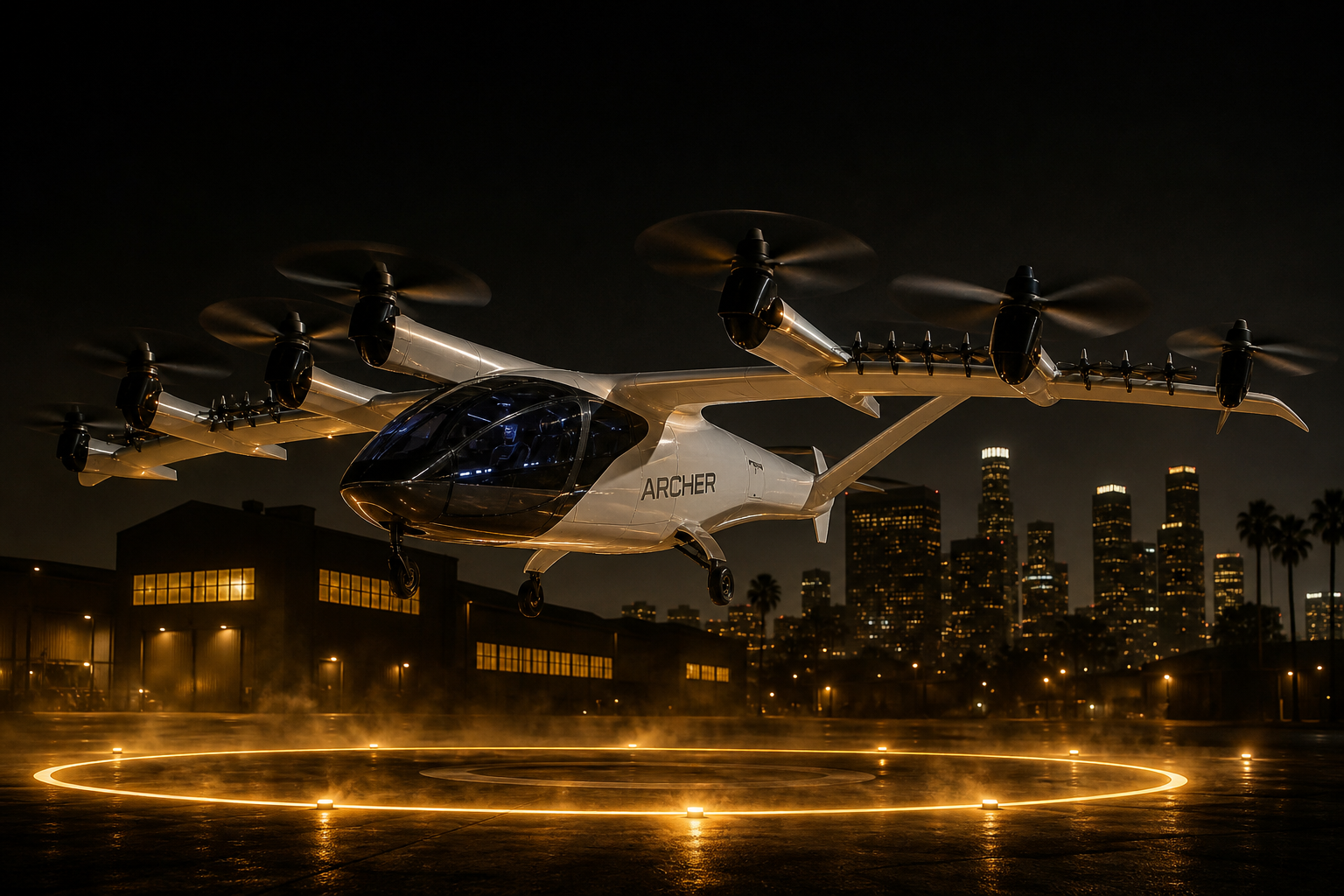
Concept render: an Archer-style piloted eVTOL lifting off from the campus vertiport at night
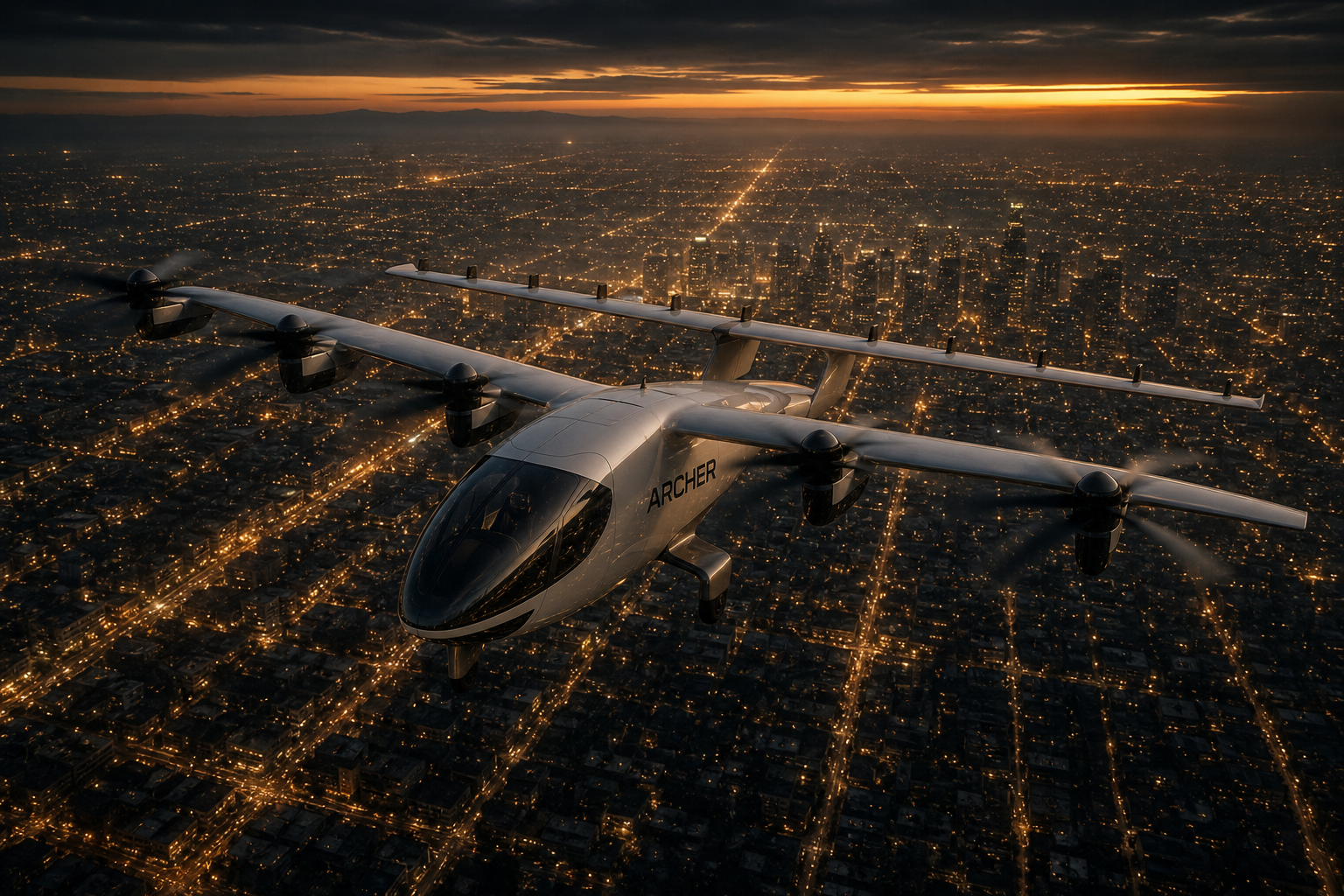
Concept render: an Archer-style eVTOL in cruise flight over the Los Angeles basin at dusk
THE AIRCRAFT — MIDNIGHT

Twelve propellers, built for the shuttle run.

Midnight is a twelve-propeller lift-and-cruise aircraft: large tilting propellers for forward flight mounted in a staggered tandem-wing arrangement, with redundant smaller lift propellers distributed across both wings. The design brief is the 20–50 mile urban shuttle — airport to city center, stadium to stadium — flown continuously, with twelve minutes of flight and twelve minutes of charging in a repeating cycle. A pilot flies it from a conventional cockpit; passengers sit in a four-abreast cabin.

Archer Midnight — Program Card
CompanyArcher Aviation (NYSE: ACHR), San Jose, CA — founded 2018
AircraftMidnight — battery-electric, 5 seats (4 passengers + pilot)
ConfigurationLift + cruise: 12 propellers on staggered tandem wings
Range~50 miles typical mission (company target)
CertificationFirst through Phase 3 of 4, FAA type certification; UAE Restricted Type Certificate track
Launch marketAbu Dhabi, UAE — Launch Edition with Abu Dhabi Aviation; LA28 Olympics target
PartnersUnited Airlines (investor + launch customer), Stellantis (manufacturing), Anduril (defense)
MissionBack-to-back urban shuttle hops, ~20–50 mile legs with rapid recharge
Company 03 — Honda

Honda: the regional machine.

Honda has been designing aircraft for decades — the HondaJet and its HF120 engine are FAA-certified and flying worldwide — and in 2021 it formally turned that heritage toward the air-taxi market. Its answer is different from every other entrant on this page: a gas-turbine hybrid, built not for the intra-city hop but for the 250-mile regional trip.

The full-scale technology demonstrator, registered N805HX, completed its first flight on April 1, 2026, at Honda Research Institute USA in San Luis Obispo, California. The program is now in technology validation, with FAA certification-basis work underway and a target of entry into service in the early 2030s. The powertrain pairs a compact gas-turbine generator — derived from the HondaJet's HF120 engine lineage and generator technology honed in Formula 1 — with electric motors driving the props. The campus vertiport at 1201 W. 5th Street is positioned as the aircraft's promotional home in Los Angeles.

SPECS PER HONDA PUBLISHED R&D MATERIALS, OCTOBER 2026. AIRCRAFT IN TECHNOLOGY VALIDATION.

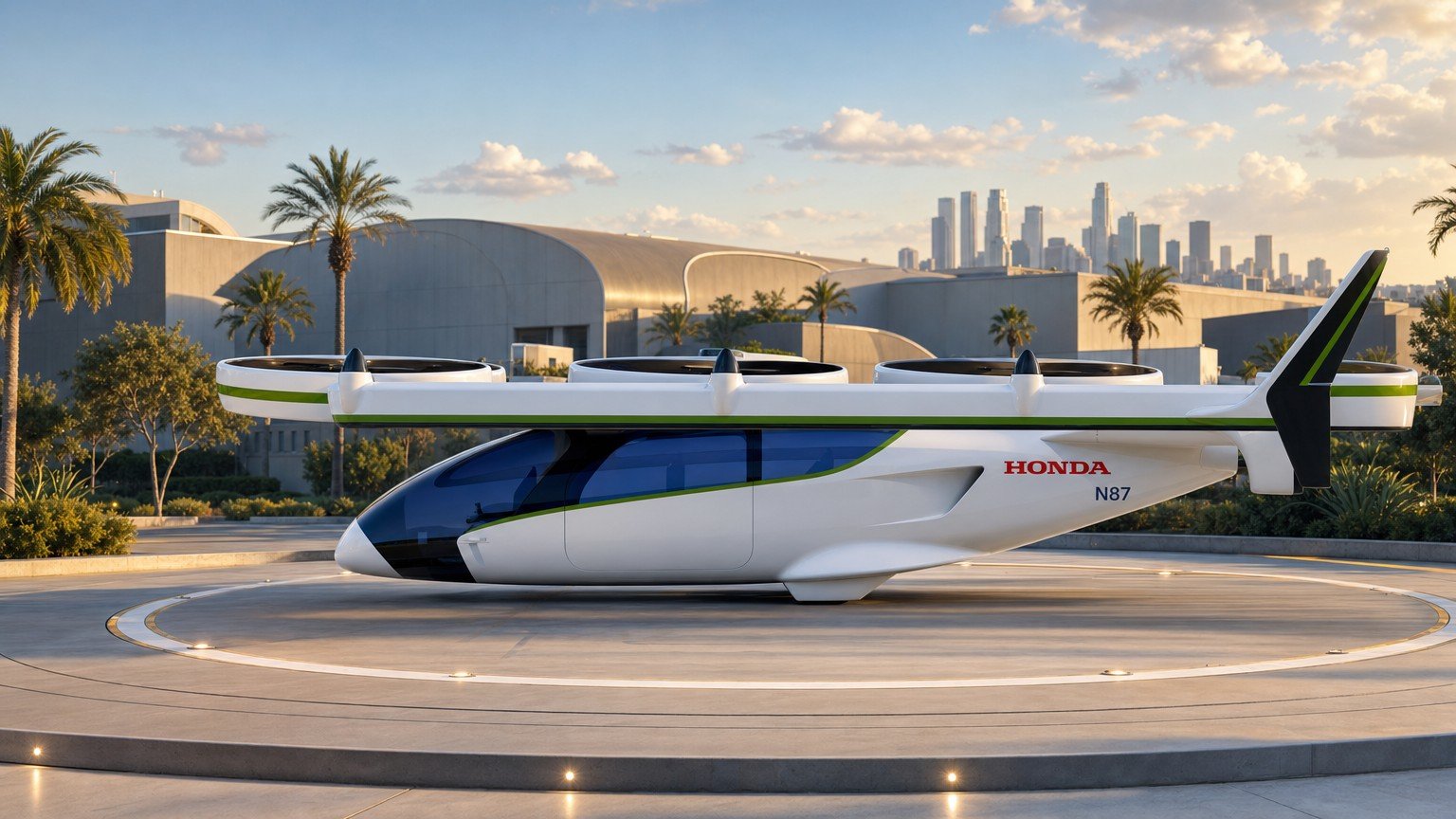
Concept render: Honda Hybrid eVTOL parked on the campus vertiport at night
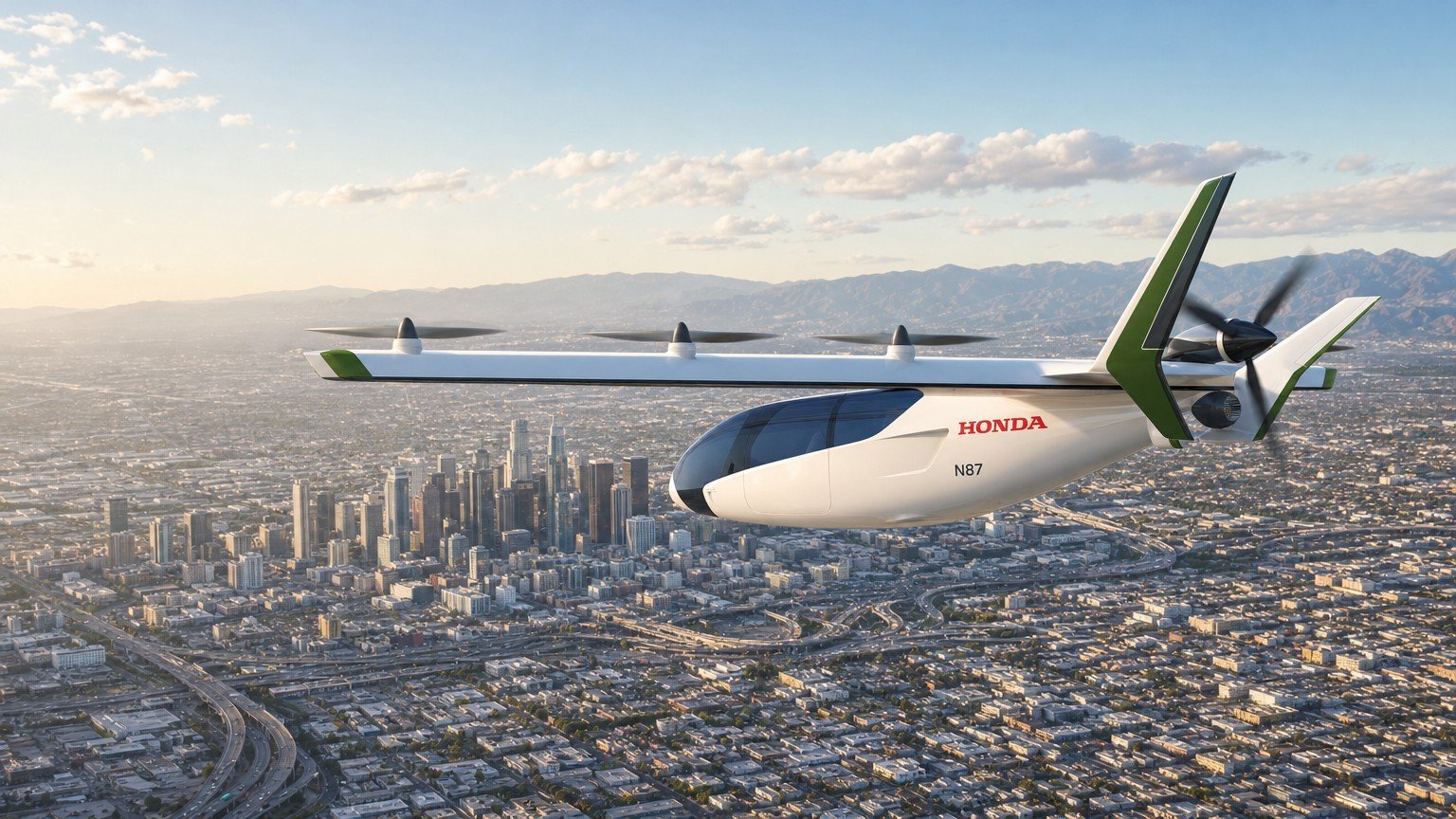
Concept render: Honda Hybrid eVTOL in cruise flight over the Los Angeles basin at dusk
THE AIRCRAFT — HYBRID EVTOL

Lift, cruise, and a turbine for the far side of the city limits.

The Honda Hybrid eVTOL is a lift-and-cruise layout: eight lifting propellers on twin booms between a forward canard and a longer rear wing, and two pusher props for cruise. The gas-turbine generator feeds batteries that drive the props, extending the target range to 400 km / 250 miles with IFR reserves. The cabin is designed for four or more passengers with one pilot, with HondaJet-informed spaciousness and automotive-grade noise insulation.

Honda Hybrid eVTOL — Program Card
CompanyHonda Motor Co., Tokyo — aircraft heritage via HondaJet + HF120 engine
AircraftHonda Hybrid eVTOL — gas-turbine hybrid-electric, 4+ passengers + single pilot
ConfigurationLift + cruise: 8 lift rotors, 2 pusher props, canard + rear wing
Range400 km / 250 miles target, including IFR reserve (company target)
PowerGas-turbine hybrid: HF120-derived 250–300 kW turbogenerator + electric motors
CertificationFAA certification basis in work; technology validation phase
Launch marketNot yet announced — early 2030s target for entry into service
MissionIntercity / regional trips — the layer between the city hop and the business jet
MilestoneFull-scale demonstrator N805HX first flight, April 1, 2026, San Luis Obispo, CA
One Campus, Three Stories

The vertiport hosts them all.

Joby, Archer, and Honda are each writing a different chapter of the same story: quiet, emissions-conscious flight between the places people actually need to go. Whichever aircraft lands first, the campus vertiport at 1201 W. 5th Street is built to receive it — and the six stages behind it are built to tell the story.

CONCEPT DEMO ONLY. This is an unsolicited concept site by Marziani InMersion Systems™, created to pitch a vision for lacenterstudios.com. It is not the official LA Center Studios website, and no affiliation or endorsement is implied. All stage imagery is AI-generated concept art. Official site: lacenterstudios.com